
Put your agents to work while you sleep
Give an agent a queue of tasks. It works through all of them in a sandbox, runs your checks, self-reviews, and leaves the results for you to approve.
- Claude Code
- Codex
- Gemini
- Grok
-
Queue up the work
Add tasks from your terminal or from any editor that supports ACP, or let your agents file what they find. Each task is a folder that says what to do and how to tell it’s done.
88% of real requests to coding agents gave only the problem, with little else, against 7% of benchmark tasks, a 2026 study found.
-
A fresh agent for every task
The loop works through the queue one task at a time. Each task starts a fresh agent session, without the previous task’s conversation.
39% average drop when top models got a task over several turns instead of in one message, a 2025 study found.
-
Checked and committed
The agent runs your checks before it calls a task done, then commits the work: one commit per task.
22.6% of the failures found in 20,574 real coding-agent sessions were the agent claiming it was done too early, a 2026 study found.
-
Accounts rotate when rate limited
When an account reaches its usage limit, the loop carries on with the next one.
20 hours a week is how long the average Claude Code user now has it running, Anthropic found.
-
Questions don’t stop the work
If a task needs your decision, the agent records the question, options and recommendation. The loop continues with the other tasks.
92.3% of coding-agent session time went to waiting on the person, a 2026 study of 4,300 sessions found.
-
Reviewed before you wake up
A final review checks completed work against each task’s requirements and reopens tasks that need more work.
About half of agent pull requests that passed the tests still wouldn’t have been merged by the project’s maintainers, METR found.
-
Good morning
Review the commits, answer the waiting question, and queue tonight’s work.
1,300+ pull requests merged at Stripe each week are written start to finish by unattended agents and reviewed by people, Stripe reported.
Safe to leave running
- Your project is mounted; your home folder is not.
- Known secret files appear empty.
- Filtered networking: your AI provider and approved destinations.
- Your host Git credentials stay outside the box.
42% of reported coding-agent file mishaps reached outside the project, into system files, personal files and secrets, a 2026 study found.
Claude Code
- ~
- .ssh/, out of reach
- .aws/, out of reach
- Documents/, out of reach
- code/
- billing/, out of reach
- Sandboxshop/
- src/
- tests/
- package.json
- .env, empty inside the box
origin, your Git remote: the agent cannot push to it
- api.anthropic.com: reachable
- any other site: blocked
- origin, your Git remote: the agent cannot push to it
The loop and the sandbox are just the start. co:op gives you these too.
-
Project services
Run Postgres, Redis and other supported Compose services beside the box, each in its own container.
In filtered mode, approved services use a private network with no direct internet access. Secret files stay hidden unless you approve access.
6.5 s to start the box with Postgres and Redis beside it, once their images are pulled, we measured.
$ coop up
Private networkSandboxClaude Code
shop/
- db
- redis
-
Presets
A preset is a team of models: one lead, and as many roles as you need. The lead consults them or hands them work.
coop presets initwrites a starter team you can change.+18 points on competitive programming problems when Claude reviewed Codex’s drafts, against +13 when Codex reviewed its own, a 2026 study found.
$ coop frontier
leadOpus 5.5- thinkerFable 5.1adviser
- criticGPT-6 Astraadviser
- fastGemini 3.8 Flasheditor
-
Forks
Hand work to agents, each in its own copy of your project, and keep working in yours.
Review a fork like a pull request, then merge it. Set a project gate to check the rebased work before merging.
16 agents in their own copies, each task claimed by one, built a 100,000-line C compiler that builds Linux, Anthropic reported.
~/code/shop $ coop fork api codex --loop -dCreating fork: api /Users/you/code/shop-forks/api✓ Started fork api in the background Agent: codex Logs: coop fork logs api --follow Stop: coop fork stop api~/code/shop $ coop fork lsForks api · ready to merge · updated 4 minutes ago Agent: codex Branch: api Tasks: 1 ready to merge Changes: +88 −6Review a fork: coop fork review <name>~/code/shop $ coop fork review api --statChanges in fork api Into: main 2 commits · 3 files · +88 −6Commits 9c41e2a webhook: verify Stripe signatures 3a7f0db webhook: dedupe replayed events by idFiles code: M src/webhook/handler.ts +40 -6 A src/webhook/verify.ts +24 -0 tests: A tests/webhook.test.ts +24 -0Project checks will run when you merge.~/code/shop $ coop fork merge apiMerge fork api into main 2 commits · +88 −6Merge these commits? [Y/n] yRebasing onto mainRunning project checks Running: npm test✓ Merged fork api into main -
Integrations
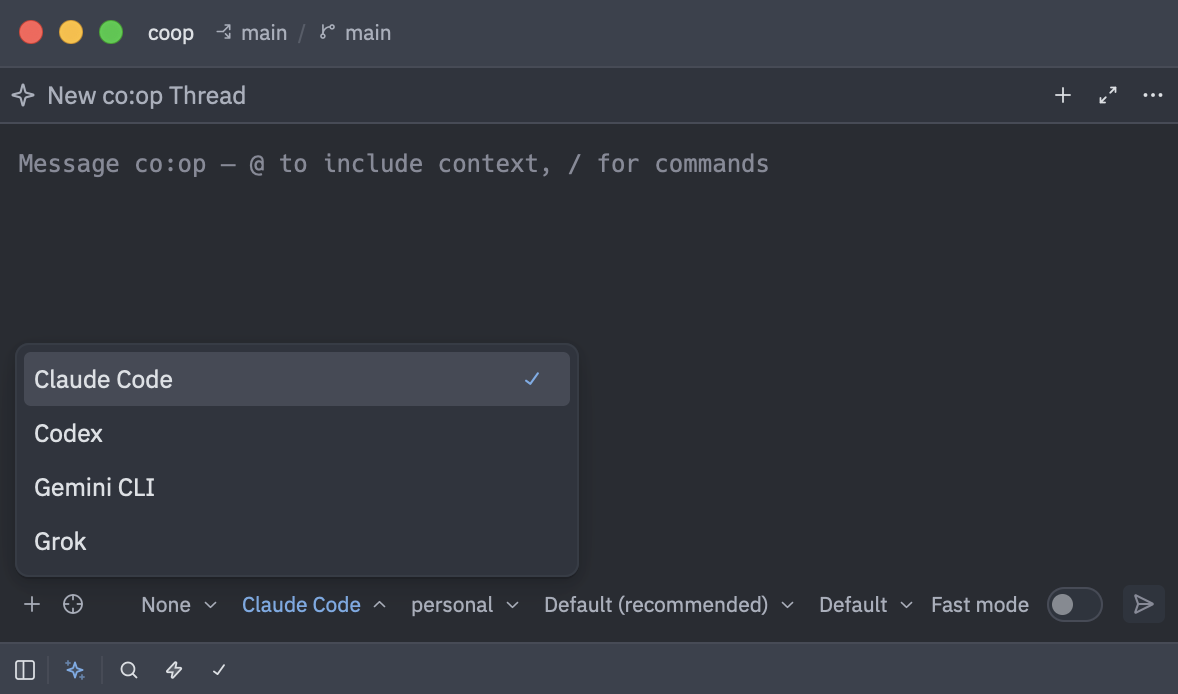
Use Zed’s agent panel to plan work and add tasks to the queue.
Any editor that speaks ACP works too, with account rotation built in.
Get started
Free and open source. Runs on macOS and Linux with Docker.
curl -fsSL https://coop.dryga.com/install.sh | sh coop login claudecd your-project && coop initcoop loop claude